








[ad_1]
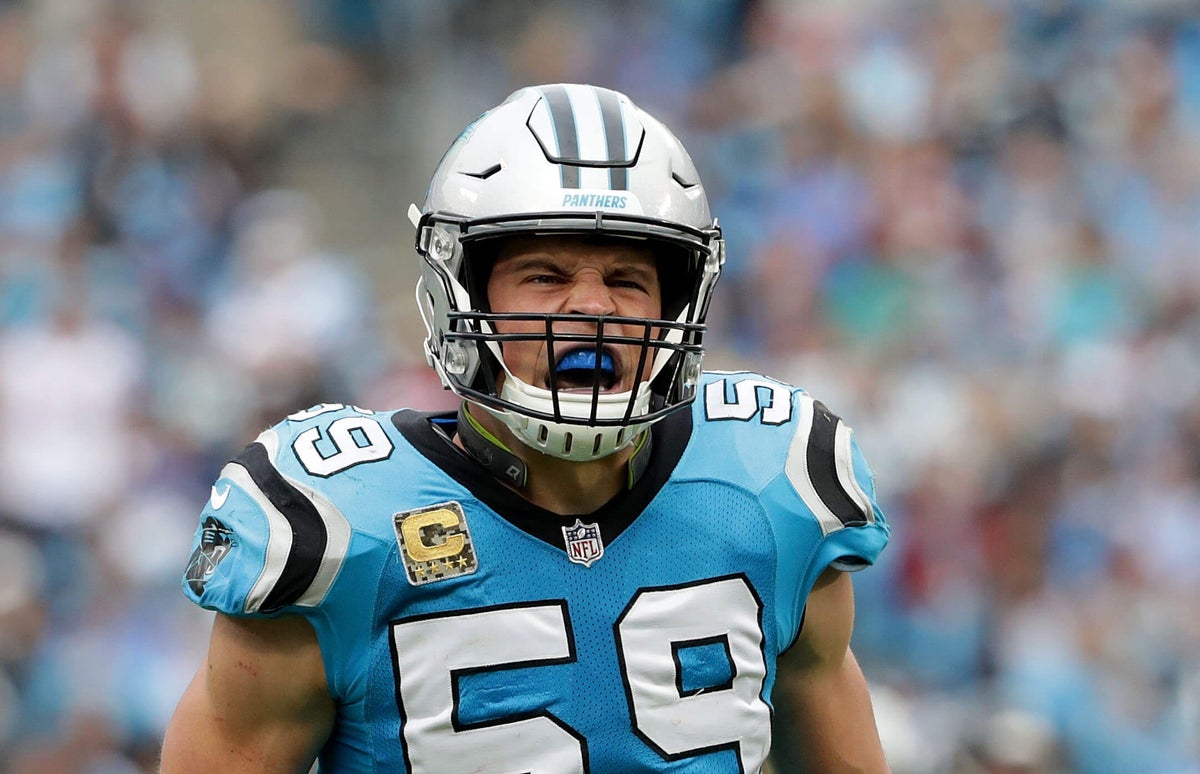
CHARLOTTE, N.C. — Luke Kuechly moved into a new home last year. Everyone in his neighborhood knows him. Everybody in the Carolinas knows Kuechly, the retired Carolina Panthers linebacker who still retains a boy-next-door charm at 35.
But when Kuechly takes his dog Ivy for her morning walk, neighbors are more interested in greeting the 6-year-old black Lab than bugging him about his football exploits.
“Everybody knows the dog more than they know me. ‘Hey, Luke, good to see ya. Hey, Ivy!’” Kuechly said. “If you walk dogs and you have a dog, nobody cares about you. They just care about the dog.”
That’s fine with Kuechly, who had a way of deflecting the attention even as he was going to Pro Bowls and earning All-Pro honors every year after the Panthers drafted him ninth overall in 2012.
“I just want to be somebody, the same person who lives in the neighborhood just like everybody else,” he said.
How Luke Kuechly’s humble stardom paved the way to the Hall of Fame
Joseph Person
Maintaining a low profile might get a little tougher after Aug. 8, when Kuechly becomes the first player who spent his entire career with the Panthers to be inducted into the Pro Football Hall of Fame. With a gold jacket — and a bronze bust on display a few hours from his Cincinnati hometown — there figures to be more demands on Kuechly’s time.
“I don’t know,” he said. “I guess that’ll be a question for some of these guys up in Canton — what in your life do you feel has changed since you’ve been in the Hall of Fame?”
Those who know him well wouldn’t expect much to change with Kuechly, an avid hunter and workout buff who — more than six years after retiring following a series of concussions — looks like he could still play.
Within a couple weeks of the Hall of Fame announcement in February, Kuechly called Greg Olsen concerned about how the ceremony would impact their Charlotte Christian middle school team.
“He’s like, ‘Dude, what are we gonna do? That’s the first week of training camp,’” Olsen said. “I’m like, ‘Luke, we’re gonna cancel a day or two of middle school training camp because you’re getting into the Hall of Fame.’ But that’s where his mind immediately went. ‘Because this is gonna be about me, it’s gonna alter everybody else.’”
After the Canton activities conclude, Kuechly will return to Charlotte and continue in his analyst role with the Panthers radio network and serve as Olsen’s defensive coordinator for the middle-school Knights. Kuechly also will serve as Netflix’s lead analyst for five games this season.
The Athletic spoke to 10 of Kuechly’s former teammates and coaches — as well as a longtime NFC South quarterback — about their favorite Kuechly moments, his ability to know what an offense was going to do before the ball was snapped and how a player with his abilities and stardom remained so humble.
(Some answers have been edited for clarity or brevity.)
How would you describe Luke Kuechly to someone who’s never met him?
Jordan Gross, Panthers Hall of Honor, offensive lineman (2003-13): “Kind of a dork. Just an incredibly normal, nice, considerate person if I’m describing my friend Luke. And the football side, just whatever adjective you can come up with — outlandish, fantastic, generational — processor of information.”
J.J. Jansen, Panthers long snapper (2009-present): “He’s the humble superstar. Everything about him is superstar. He’s a great athlete. He’s good looking. He’s smart. He could be the pitchman for anything. He’s got such a clean-cut image and yet he is the most humble person you can be around.”
Sean McDermott, former Bills head coach and Panthers defensive coordinator (2011-16): “Inquisitively intelligent. Your next-door neighbor’s son and he’ll tear your head off at the same time.”
Roman Harper, Panthers safety (2014-15): “He’s the nicest human being you’ll ever meet in your life, almost uncomfortably nice.”

Luke Kuechly was Defensive Rookie of the Year in 2012, NFL Defensive Player of the Year in 2013 and made the Pro Bowl in seven of his eight seasons. (Ron Chenoy / Imagn Images)
Ryan Kalil, Panthers five-time Pro Bowl center (2007-18): “If you are someone who has daughters, Luke’s the kind of guy you hope that your daughter marries. We would joke he’s Captain America, and we would give him hell a lot in saying that, ‘One day we’re gonna find some skeletons in your closet. I don’t know when that’s gonna happen, but you can’t be this good of a guy, this amazing of an athlete and football player, this consistent of a good man.’ But he is. He was raised right and he’s somebody of incredible character, and I think that is a big part of why he is a Hall of Famer.”
Harper: “A lot of players lived at the Vue (a luxury high-rise in uptown Charlotte). I’d be getting out of the car with my wife (after) getting groceries, with one or two of my kids. And he’d go out of his way to run across the parking lot to help me remove my groceries and take them up to my room, or try to help with a kid. It’s like those things. Football is (one) of the last things I bring up when it comes to Luke Kuechly, just because he’s that different as far as how nice he is.”
Kuechly led the FBS in tackles in his final two seasons at Boston College and won the Bronko Nagurski Trophy in 2011 as the nation’s top defensive player. Still, when he arrived in Charlotte, he didn’t look as physically imposing to players and coaches as the team’s first-round pick from the previous season — Cam Newton, a 6-5, 245-pound quarterback.
Mike Tolbert, Panthers fullback (2012-16): “I remember after we drafted him, we were out on the practice fields. He had his glasses on. He had that big, curly, black hair. And I’m like, ‘TD (Thomas Davis), who the f––– is that?’ He was like, ‘Boy, that’s our first-round draft pick.’ I was like, ‘Man, shut up.’ So he didn’t pass the eye test right away. He was really quiet in the beginning and then once he got it, boy did he get it.”
Don Gregory, retired Panthers college scouting director: “He was like Clark Kent during the week, Superman on the weekends. Nicest guy. There wasn’t a bad bone in his body. But competitive, instinctive and an extremely hard worker.”
McDermott: “When I first was around Luke at the rookie minicamp, I was like, ‘Hmm.’ He was doing some drills, I’m like, I’m not sure. How’s this gonna be, first-round pick? But boy oh boy, you start playing the game of football and the ball gets snapped, and that guy has incredible processing speed. It’s one of the first times I really learned about the importance of processing speed.”
That unassuming demeanor off the field belied Kuechly’s natural athleticism and fierce competitiveness on it. During Kuechly’s first FanFest in 2012, he beat Gross with a double-move on a blitz, ironic because rushing the passer was one area Kuechly believed he was lacking. Man coverage was another.
Gross: “It was like a pass-rush move that a rusher would do. Luckily the ball was gone, so no one knew the difference. But I remember thinking, how the F does this rookie who’s 20 years old understand that already? And I don’t think that Luke was in the lab practicing pass-rush moves for hours on end. I just think he just understood that I had him beat and he was about to run past the quarterback. So the logical thing to do was to spin back underneath.”
Matt Ryan, Atlanta Falcons QB who preceded Kuechly at Boston College and played against him twice a year for eight seasons: “Everybody talks about him as a player and how smart he was. But he was a hell of an athlete, too. I watched him a ton when he was at BC and heard from the coaches there about what he was as a player, and then saw it firsthand for a long time going against him.”
Harper: “As good as he played the pass game, he hated playing man-to-man coverage. He was like, ‘Ah, I’m not good at it.’ It’s crazy. He never felt comfortable in man-to-man coverage and he hated blitzing, too. So he always sent Thomas Davis as much as he could. He was like, ‘I’d rather Thomas go and I just go play pass.’”
Kuechly: “On a lot of our pressures we had creativity based on what the offensive line was doing to send Thomas or myself. So any opportunity we (had) to manipulate that offensive line protection call, we would. Because Thomas loved blitzing and he was really good at it. And I frankly was not very good at it and didn’t enjoy it.”
McDermott: “You blitz Thomas, he was a razor blade. He was gonna cut you up every way possible to get to that quarterback. And Luke, that wasn’t his forte. But he did get better at it as time went on. And I think he learned a lot being around Thomas. Those two, they’re an unbelievable duo. They were totally different players but I think they really learned from each other and helped each other, too.”
Kuechly: “Thomas liked playing man because he’s such a great athlete. He’s long and physical. I’d rather just sit back in zone and see what’s going on and be able to cheat routes and rally (to the ball) and have my eyes on the quarterback and be able to see route combinations.”
Kuechly’s tireless film study and knack for calling out the opponent’s offensive plays became the stuff of legend. Everyone who coached or played Kuechly has a story about seeing him holed up in the linebackers room at Bank of America Stadium in a “Late Night with Luke” film session.
Ron Rivera, Panthers all-time winningest coach: “It was Christmas Eve and he was watching film. I told him, ‘Luke, you need to go home.’ And he said to me, ‘But my family’s not here yet, Coach. So I got time.’ I said, ‘OK, I’m gonna give you one more hour. If you’re still here, you and I are gonna have a talk.’ So when I went back downstairs to check on him, he had just left. The bulb was still hot.”
Kalil: “One Friday during the season, I had stayed in longer for physical maintenance. I think I had a bum ankle or something. I left the facility and came back to get a second round of treatment. And I was there late that night. My plan was to do that, shower and then I was gonna go meet the guys for dinner. And Luke had been there all day. And I was like, ‘Are you coming to dinner with us?’ He’s like, ‘No, I still have two more games I wanna go through.’ And I just looked at him and smiled and was like, ‘That’s why you’re gonna be in the Hall of Fame.’”
McDermott: “When his mom would come to visit, she would bring a pot roast or something. So he’d go home after practice on a Thursday, put whatever she had made and brought him that was in his freezer, put it on start, was warming (it) up. And he’d go back and eat it two hours later because he came back to the facility.”

Former Panthers defensive coordinator Sean McDermott works with Kuechly during the linebacker’s first training camp in Spartanburg, S.C., in 2012. (Jeremy Brevard / Imagn Images)
Ryan: “Because he was so sharp and studied so well, if you had tendencies with what you did, he was really good at being able to pick up on those. So we would game plan so we had certain things that were tendency-breakers on purpose. Sometimes it worked, sometimes it didn’t. But so many times I recall making checks or an audible at the line of scrimmage, the clock’s running down and he’d be calling out exactly what you were doing. You’d be like, ‘All right, I’ve gotta snap it. Here we go.’”
Kuechly: “What I always looked for was, where can I find my best key? Where’s my best clue to see what’s going on? Whether that’s a formation, a down and distance, key indicator in the run game or pass game, that was my approach. I think if you’re looking for plays that you know and you try to memorize stuff, that’s when you have problems.”
Harper, who spent eight seasons in New Orleans before signing with Carolina: “(Playing) for the Saints, everybody’s like, ‘Man, he just runs around blocks.’ Then when I got to see him at work every day, I was like, ‘Dude, he’s running around blocks because he knows where the ball’s going. He’s just beating you to the spot.’”
Ryan: “I played golf with him after we had both retired, and we were hanging out having a beer afterwards. All of a sudden, on a napkin, he’s asking me to draw up our wide-zone rules and our cadence and checks. And he was like, ‘I could never figure this out.’ I’m like, ‘Man, I don’t even remember, Luke.’”
Kuechly was the NFL’s Defensive Player of the Year in 2013 when the Panthers won the NFC South and began a streak of three consecutive playoff appearances. After Drew Brees and the Saints thumped the Panthers in New Orleans in Week 14, the teams played two weeks later during a rainstorm in Charlotte. The Saints ran 81 offensive plays to the Panthers’ 44, and Kuechly tied the NFL’s single-game record with 24 tackles in a 17-13 victory that clinched a playoff berth.
McDermott: “They tuned us up pretty good earlier in the season. We did some things from a game-planning standpoint in the second game that were better and allowed Luke and the crew to play faster. I remember he was going off.”
Kuechly: “It was raining so hard that it was difficult to throw the ball, obviously. It was so much rain that it wasn’t a clean playing field. It wasn’t like guys were moving super-fast. So if you can just get to the right place, you’re usually in business.”
Harper, who was still with the Saints at the time: “I just remember them calling out his name a lot. The crowd kept saying, ‘Luuuuuuke.’ Over and over and over. I was like, ‘Damn, what are we doing?’ Honestly, before I was his teammate, I thought it was what the Saints weren’t doing correctly. But then when I became his teammate, it’s really just Luke being Luke.”
Kuechly’s highlight reel ran deep. He intercepted Tomy Romo twice in the span of two plays — returning one for a TD — during a Thanksgiving Day romp at Dallas during the Super Bowl season of 2015. He added pick sixes in back-to-back playoff wins against Seattle and Arizona, then made a game-high 10 tackles to go with a sack in a 24-10 loss to Denver in Super Bowl 50.
Tolbert: “If you’re asking me about Luke’s great games, I would ask you, which one?”
Gross, who was on the radio broadcast for the Dallas game in ’15: “I was on the sideline for that. That was incredible. He knew that play was coming. They practiced it. He baited Romo and then the best part is he jacks him in the face (on a stiff arm in the end zone). That’s just awesome.”
Josh Norman, a first-team All-Pro cornerback in 2015 who played five seasons in Carolina: “The Super Bowl, oh my gosh. Demaryius (Thomas) caught the ball and he came through him and mauled him (jarring the ball loose for an incompletion), like straight face-planted him. (Kuechly) got up, hit his head (celebrating), went to the sideline. I came and jumped on top of him. I about thought I broke his vertebrae or something, how I jumped on him. I was so hype. I even get chills while I’m talking about that.” (Norman did in fact have goosebumps on his arm describing the play.)

Kuechly’s hit on Demaryius Thomas in Super Bowl 50 against the Broncos: “Straight face-planted him,” Josh Norman said of the play. (Cary Edmondson / Imagn Images)
McDermott: “He was calling out plays that (the Broncos) were running, which is not odd for him. But you’re talking about the Super Bowl and Peyton Manning, and here’s Luke calling out, ‘Screen’s coming.’ That’s the pinnacle right there. To do it in the biggest game of the year against one of the best quarterbacks of all time — it’s not like he was calling ‘em out (in) a preseason game and he’s going, ‘OK, I’ve seen this play before.’”
Kuechly could be a menace to teammates, as well, whether it was blowing up the offense’s plays and trash-talking or yelling at defensive teammates to get in the right spot.
Olsen, the Fox color analyst and three-time Pro Bowl tight end: “We’ve been working on this trick play and we’re gonna run it in practice. And Luke just absolutely ruins the entire play. Saw it, sniffed it out, damn near took the reverse in the backfield. The rule going forward was Luke was not allowed in practice if we were ever trying to work on something as a first-team offense. Because we’re like, ‘Well, Luke’s not going to be in the game to ruin that for us, so we’re just gonna count on the other guys falling for the trick.’”
Jansen: “I’ve only been yelled at on the field three times in my life by other players. All three were Luke Kuechly, trying to line his guys up for field goal block. And I’m trying to get the field goal team going, and he’d get mad at me for trying to go too fast before he could organize his guys. On the field, he’s a maniac. And then we’d come to the locker room and he’s like, ‘Hey, I’m sorry about that. I just wanted to get my guys lined up.’”
Norman: “He was a phone booth guy. Like he’s a normal, casual, regular citizen — glasses on, got a tie, suit, walking in with a briefcase. But when it turned night or it’s green grass, he goes into a phone booth and he’d become the Terminator. Y’all think I was bad. Y’all think I said some things. You ought to see what that guy said. He was like two times worse than me, but he got away with it because he was inside the trenches.”
Sixteen days after the Panthers’ disappointing 2019 season ended with a 42-10 loss to the Saints, an emotional Kuechly announced in a video released by the team that he was retiring at the age of 28. He said he didn’t think he could play the way he had since he was a kid — fast, physical and strong. Kuechly had missed seven games due to concussions from 2015-17, though he didn’t cite those in his retirement video.
Jansen: “At the beginning of 2019 in training camp, he missed a couple of days of practice. I don’t know if there was a concussion there. I don’t know if it was a scare. But I remember that happening and personally being worried. He went through that season, I think he made all 16 starts. I could tell on the field he wasn’t playing the way he normally plays. And yet I think he was fourth or fifth in the league in tackles.” (Kuechly’s 144 tackles ranked fifth in 2019.)
Olsen, recalling a conversation with Kuechly in the weight room near the end of the ’19 season: “He’s like, ‘Hey man, I’m done. I just can’t do it.’ I remember being like, ‘Yeah, I get it. I’m done, too. This year’s been tough.’ And he’s like, ‘No, I’m done done.’ I don’t think we got much more done in our workout. We ended up just standing there kind of chatting and sharing.”
Rivera, who’d been fired with four games left in ’19: “I was one of the people that helped make the decision to sit him down (late in) the 2016 season, and just say, ‘Look, Luke, you know what? It’s not worth it.’ He trusted me enough that he came to my house to tell me that he was gonna make that decision. All I wanted him to know was I supported it, just because I’m glad he’s thinking in those terms of taking care of himself.”
Kuechly: “In my heart I always felt like it was the right decision. As much as I knew I was gonna miss playing the game of football, I knew it was the correct decision in that moment. So once that happens, you’re pretty much at peace with it.”
Rivera: “The unfortunate thing is we only got to see eight seasons, and I know he would’ve had an even more stellar career. That was probably the hardest thing for him. But for me personally, it was hard also because I had so much love and respect for him, and I knew how much he loved the game. But I also am happy he decided to step away when he did. To be able to walk away from the game as relatively healthy as he is I thought was awesome.”
[ad_2]
Source link