







[ad_1]
Most NFL assistant coaches aspire to one day lead their own team.
Although entrusted with their areas of expertise, coordinators often run through the big decisions that come with the head coaching title. Then, those fortunate enough to become head coaches truly find themselves in the driver’s seat.
The jump from leading assistant to the head football coach proves quite significant, and in some aspects, these assistants find there’s nothing that can fully prepare them for that leap besides actually doing the job.
This past offseason, 10 teams made a change at head coach, and six of those jobs went to rookies.
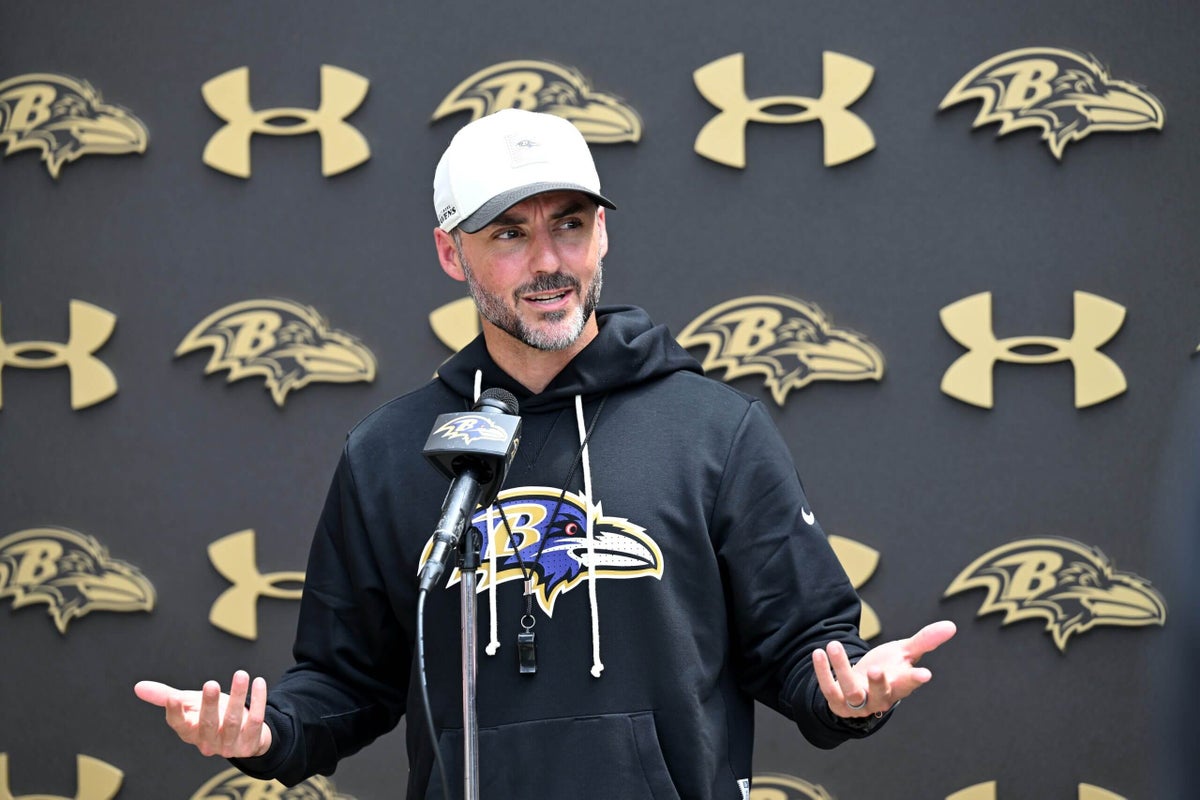
The Arizona Cardinals hired former Los Angeles Rams offensive coordinator Mike LaFleur. The Baltimore Ravens hired Los Angeles Chargers defensive coordinator Jesse Minter. The Buffalo Bills promoted offensive coordinator Joe Brady to head coach. The Cleveland Browns hired Ravens offensive coordinator Todd Monken. The Las Vegas Raiders hired Seattle Seahawks offensive coordinator Klint Kubiak. And the Miami Dolphins hired Green Bay Packers defensive coordinator Jeff Hafley, who served as head coach at Boston College from 2020 to 2023 but never in the NFL.
Since their hirings late last winter, the coaches have worked hard to lay the foundation for their rookie seasons. This encompasses hiring assistants and support staff members, planning offseason programs and practices, settling on training camp schedules, travel routines, regular season game-week preparations and more.
Most take the job with a vision, but in many ways, they’re learning on the fly, and the learning never stops.
Below, LaFleur, Minter, Brady, Kubiak and Hafley pull back the curtain in a roundtable-style Q&A and share some of the experiences, surprises and lessons learned and how they’ll apply them once the season begins. (The Browns didn’t make Monken available for an interview.)
Questions and answers have been lightly edited for length. This is Part 1 of the Q&A. Part 2 will publish on Tuesday.
How would you describe that jump from coordinator to head coach, and how are you managing to juggle it all?
LaFleur: It is a jump, no doubt, but it was fun. It’s a new adventure, if you will. The biggest thing that got me this job was what? Well, obviously some relationship stuff like that, but (being an) offensive coach, right? … There are days you want to just lock the door and just watch football and just do offensive stuff and get ready to get our scheme together, study different defenses around the league and where the trends are going. But you can’t lock that door all the time, and so that’s where I would say the biggest jump is.
You knew it was going to be that way, but there’s just times it’s like, “I don’t want anyone in here,” but guess what? I’ve got to open that door and I’ll find more time in other places. … You’ve got to ration, and also, just like Sean (McVay) did, just like Kyle (Shanahan) did, just like all the head coaches, “Hey, (Nathaniel Hackett, Arizona’s offensive coordinator), I need you to do this. Hey, Justin Frye, our O-line coach, I need you to do this.” You’re hiring guys because you trust them, so allow them to do their jobs.
How a ‘small scope’ will make Mike LaFleur successful in Arizona
Robert Mays
Brady: I don’t think it’s really any different than a jump from QB coach to offensive coordinator. Like you’re balancing, obviously, a lot more things, and everybody’s looking to you to make a decision. But it’s really — from an offensive coordinator perspective, everybody on the offensive side was looking at you. Yeah, you’re having to deal with a lot more in other areas, in other parts of the building. That’s the transition of making sure everybody is communicating and speaking in your language.
It’s probably not the hardest for me because I’ve been in this building before. So I have a little better feel of how systems have flowed. … But I’m day by day, figuring it all out. I just surround myself … I’ve got a great performance staff, a lot of great coaches. … I don’t have to do everything. But I enjoy making sure everything’s exactly to the standard, so, so far so good.
Minter: It’s a major jump in time management and setting a schedule that you feel like is the best for everybody, and that’s almost impossible. You’re trying to look at it just from like, “What gives the team the best chance to improve every day, work on football, not have to worry about all the other stuff?” You try to handle a lot of that stuff yourself, so it doesn’t bother other people. I think you try to hire a great staff that you can impart your philosophy to and that you don’t have to then turn around and micromanage.
So hiring the right people, particularly for myself as a defensive guy, you know, it was Declan (Doyle) on the offensive side, Anthony Levine on special teams — getting guys that the messaging is going to be really consistent from my standpoint, and that we’re going to try to play the game with the identity that we want to see. So that’s been really fun to do that, and a good challenge as well.
Kubiak: It’s been a great challenge, but I think the biggest challenge is ahead, and that’s managing the game and managing the game plan throughout the week. So that’s to be seen. The offseason itself, I got to hire so many really great people that I trust, and that makes life a whole lot easier. From my offensive coordinator (Andrew Janocko), a guy that I’ve worked with a ton, our special teams coordinator (Joe DeCamillis), who I’ve worked with before. Our defensive coordinator (Rob Leonard) is a guy that I’m now learning. But I trust them, and I think just having the people on staff that you can lean on is what has been really helpful, because there is so much work to get done, and definitely too much for one person.
Hafley: When you’re a coordinator, you’re dealing with one side of the football, and in a lot of ways, with Matt (LaFleur) in Green Bay, I was the head coach of the defense, and he called the offense. So it’s a really good learning experience there. And you’re leading a smaller group, right? And most of it is about the defense and the installs, and coaching those guys up. Whereas the head coach, you’re involved with everything: offense, defense, special teams.
As the head coach, you’re involved, and you’re really in charge of the entire staff, and then obviously everything that goes into the day to day, from setting up the schedules and everything. Fortunately, Matt was really good with me, and I sat in and helped him do a lot of that stuff, and kind of got a jump-start on it. But there’s a lot more behind the scenes that is not just football. That people probably have no idea what goes into that.
When I got hired at BC, I was just turning 40 years old, and I probably was not ready. I don’t know if anybody’s truly ready their first time because there’s things that are going to pop up, and you’re going to be like, “Oh my gosh, I can’t believe I have to do that as a head coach.” Probably even more so in college with everything that you have to deal with. But I definitely feel more prepared.
This wasn’t the first time I had to hire a staff, and it wasn’t the first time I had to sit in the front seat in the staff room and get up in front of the whole football team. … I’m not going to make too many comparisons and say, “Been there and done that,” because this is new. It is the NFL, and it is different. So there’s still a lot that I do have to learn, and will continue to learn through experience and through leaning on other people.

Jeff Hafley had college head-coaching experience at Boston College before taking the Dolphins job. (Megan Briggs / Getty Images)
What’s the silliest thing that has come across your desk that you had no idea fell under head coaching responsibilities?
Minter: Some of the mail that we get from our fans. Like, I’m getting invited to different weddings and different events of people that I’ve never met that I have no idea who they are. They’re just diehard Ravens fans, so you know, it’s kind of funny. I’ll send a note just to like, congratulate them, but obviously, I’m not going to show up at some random person’s wedding. So, just those types of things. You don’t realize the limelight and what it’s going to be like until you’re definitely in the seat.
Hafley: I dealt with probably more silliness (at Boston College) than you could imagine with everything that goes on in college football, from all the NIL or the transfer portal to everything else. Anything that might seem silly here is not as silly as (college) was. … I kind of have learned that things are going to come up daily that you didn’t expect. You might have a to-do list of 10 things, and all of a sudden, six new things pop up. Someone comes in your office and says, “I need you for this. This just happened to a player. We need you for this. I need you to talk to this person.” And so it just goes on and on and on, and you just do your best each day to try to get as much done.
My first go-round, I felt like I never got anything done. Something came up every two minutes, and it’s like you go to bed at night, and it’s like, “Oh my gosh, how am I going to do this?” And then you learn to just do your best every day. There’s always going to be work the next day; rely on your staff that you’ve hired and you trust, and delegate. I have definitely learned to do better now. And then you wake up and you continue to chop away at it.
Kubiak: I feel a little embarrassed. I don’t have a funny answer for you yet. I’m sure that’s coming now that I say that. I jinxed myself. … I honestly think the thing that I didn’t think about is when Matt Capurro, who’s our chief of staff, asked me where I want people to sit on the airplane. I really never thought about that before, and “What’s the dress code for the airplane?” Two things that probably don’t affect the game very much, in my opinion. So that one was a little off the wall, but yeah, just those organizational things that, when you’re a coordinator or position coach, are important, but you just have never had to think about.
Brady: I’ve got to be careful how I answer this one. (Laughs.) There’s a lot of surprises, but nothing surprises me anymore. … There are lots of (things) that you don’t think of, but my message to basically the entire building is, “Don’t assume anything.” So, it’s making sure that we show them exactly, or we’re clear about what we have to wear, what we have to do, where we have to be there, because you start realizing like, “Wait, I didn’t know I had to say that.”
LaFleur: You get asked what kind of pens you want, where do you want the whiteboards? Like, just give me a pen that works. Give me a whiteboard on the wall. Like, I don’t really care. Make it your best judgment. I got other stuff to do that’s more important. But the silliest thing truly was I had a football on my desk about two months ago, and it said, “Can you sign this?” And I brought in my assistant, Jay, and I said, “Who’s this for?” And he kind of looked at me, goes, “Your dad. He didn’t want to ask you.” … That’s extremely embarrassing!
What was the best piece of advice you received about making that transition from coordinator to head coach? And who did it come from?
Kubiak: That would be from my dad (longtime coach Gary Kubiak), who has told me throughout my whole career, “It will get done.” You don’t always know what’s coming and you may not have enough time in the day to get to a thing. But, he said, “It’ll get done,” and he worked with Mike McCoy (my assistant head coach) for a lot of years in Denver, and he told Mike the same thing. It’s been a really good piece of advice, honestly, because you look at a list of things to do, and you just kind of attack it one at a time, knowing that in the end, it’s gonna get done. We’re gonna play these games and kick the ball off whether you’re ready or not. So that’s what’s always stuck with me.
Brady: Just be yourself. There’s a reason you’re in this position. Whether you succeed or whether you fail, make sure you’re being yourself through all that because you don’t want to go through the process and it not work out and be like, “Well, I lost my way. I tried to change who I was. I tried to do things differently.” So, stay true to yourself, and honestly, that was from a lot of people. I had some guys that I didn’t know that reached out to me that are head coaches. I had guys that I’ve leaned on. But that was basically the biggest message: Coach your coaches, and then make sure that you don’t change who you are.

Joe Brady, who isn’t new to Buffalo, keeps in mind advice to stay true to himself. (Joe Hrycych / Getty Images)
Minter: Jim Harbaugh, who really had a major impact on me growing the last four years and being ready to be in this position, and it was just to, “Go be yourself. You’re ready for this. I wouldn’t tell people you’re ready and pump you up if I didn’t think you were ready to be really successful.” And so, I think that’s a really interesting thing because I think when you get the job, the first thing you think is you almost got to try to please a lot of people, but at the end of the day, you’ve got to be true to yourself, what you believe in, share your messaging with the team of why you believe in certain things, and I think when you build that connection and explain things and talk it out, then they really understand and buy into it.
LaFleur: So many pieces of advice, but the one that was consistent amongst the guys that I would say are closest to me, and it came from my brother (Matt LaFleur, head coach of the Packers), but it came from so many other people as well, but it’s, “Don’t try to get it all done in one day.” And that really pertained in that first month as you are interviewing people, building your staff, getting to know your players, getting to know (GM Monti Ossenfort), getting to know the draft, getting to know the free agents, trying to get your scheme.
It’s like if you look at it in that big picture, just like our players, if they’re looking at it like it’s a 17-game season, that’s overwhelming. If you’re looking at it like, “Hey, man, we got practice at 1 tomorrow.” Oh, shoot, we can all handle that, right? We can handle one practice, and so it’s kind of in that same realm where it’s just like a singular focus, and in certain moments, and then just keep chipping away at it.
Also, John Lynch said something very similar to me when I took the New York job back in 2021. He said, “Hey, I know now it’s your show (as offensive coordinator) with a defensive head coach. You’re going to have a lot on you, not obviously as much as a head coach, but from a schematic standpoint, evaluation, so just try to get three things done every day.”
Hafley: The one thing that stuck with me — and it really pertains to everybody that will become a head coach — is, as an assistant and even as a coordinator, you have so many suggestions, right? If you’re an assistant and you talk to your coordinator, it’s, “I like this play. Why don’t we run this? Why don’t we do this?” Or it’s like, “Hey, how do you want to run practice? Oh, I think we should do another period, or I think we should do a red zone period.” And it’s just suggestion after suggestion after suggestion.
The moment you become a head coach, it’s decision after decision after decision after decision, and you need to be ready to quickly make decisions, and you can’t sit on all of them. You can’t sleep on all of them because it could even be another department saying, “Hey, how do you want to do this? How do you want to do this and travel? What do you want to eat here? How do you want the nutrition to be?” And it’s no longer a suggestion. Make the decision, be decisive and move on. I don’t recall who told me that, but I should.
Buffalo Bills beat writer Joe Buscaglia contributed to this report.
[ad_2]
Source link