












[ad_1]
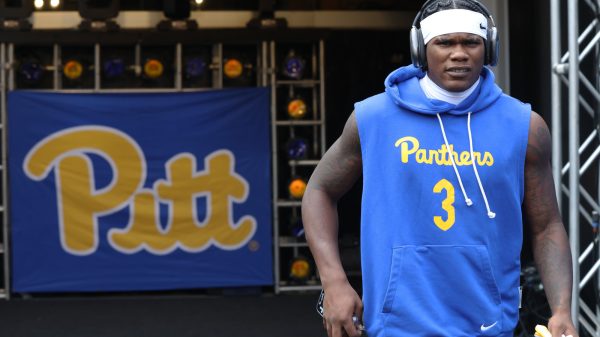
LATROBE, Pa. — Every year, often more than once a year, DK Metcalf gives some of his salary back to the NFL.
In 2024, his final season with the Seattle Seahawks, the wide receiver was fined twice for a total of more than $33,000. Last year, after signing a $132 million contract extension with the Pittsburgh Steelers following a trade, he was docked another $26,000 for fighting and making an obscene gesture.
When an NFL player is fined, the league withholds that money from their next game check and donates it to either NFL alumni in need or various charities. There’s a good chance Metcalf will be generous again this season.
Surely, he must grow tired of it.
“They say it’s going to a good cause, so I might as well win Walter Payton Man of the Year,” Metcalf says. “So no, I’m not tired of it.
“If they want to make football soft, then I’m not going to be one of those guys that conforms to a soft league.”
On a summer afternoon in Western Pennsylvania, Metcalf had plenty to say: about watching his former team celebrate a Super Bowl without him, about Russell Wilson and Aaron Rodgers, about his fondness for conspiracy theories (do you know what’s really going on inside Antarctica?).
He also has thoughts about the anger management issues you possibly — well, probably — think he has.
Metcalf refuses to let rookie receivers Germie Bernard and Kaden Wetjen call him “unc.”
He still feels young, and he still talks trash with the guys. At 28, this marks the first time Metcalf is the most tenured receiver in his room, part of the oldest Week 1 roster in the NFL.
He can remember his 2019 rookie season in Seattle and practicing with veterans Tyler Lockett and Jaron Brown. He was expecting some sort of rookie hazing — maybe they intentionally tell him the wrong play — so he was constantly spring-loaded and standoffish. It took a few days for the vets to notice something was wrong; they told him they were there as a resource.
That’s when Metcalf realized veterans can help the younger guys, but only if they want to be helped. Still, he first wants the rookies to bump their heads a bit early on and learn they can’t do all this on their own.
Metcalf says he doesn’t talk much in the position room. When the younger guys break to go to special-teams meetings, he’ll go up on the board and write out the route concepts of all the receivers. He wants to know where everyone will be and where the ball is going. The ball is going to come to Metcalf, but this helps him learn the offense in Year 1 under Mike McCarthy and Year 2 with quarterback Aaron Rodgers.

Aaron Rodgers and Metcalf have a tight bond for reasons both on the field and outside of football. (Justin K. Aller / Getty Images)
Metcalf was never a team captain during his first seven NFL seasons, and the Steelers aren’t doing year-long captains in his eighth. This, also, doesn’t bother him. “Just being respected by my teammates more than anything is what I look at the most. Just because I got a C on my chest or don’t, doesn’t mean that my teammates won’t listen to me or won’t respect me at the end of the day.”
A two-time Pro Bowler, Metcalf had three 1,000-yard receiving seasons through his first five years, but he hasn’t hit that mark since 2023. In the past two years, 35 receivers and one tight end have notched 1,000 yards, and eight of them have done it in both years. Metcalf says it’s not a goal.
“I mean, I’ve done it, so me doing it again is proving what to anybody?” Metcalf says. “I want to win the Super Bowl and I’ll let the rest speak for itself.”
Well, then, speaking of the Super Bowl…
The team with which he spent the first six years of his career just hoisted the Lombardi Trophy in its first year without him. No ball-knower would say the key to the Seahawks’ success was subtracting Metcalf, who grew frustrated with his role under one-and-done offensive coordinator Ryan Grubb in the season before Sam Darnold arrived.
Metcalf requested a trade and Seattle listened, in part because the Seahawks suspected they would have to pay Jaxon Smith-Njigba sooner rather than later. The Steelers sent a second-round pick to Seattle for Metcalf after years of searching for a top wideout. They then signed him to a four-year extension that, at $33 million per year, made him one of the highest paid receivers in the league. He has no regrets.
“I live with my decisions every day… they’re very well thought-out decisions to where I know the consequences, know my benefits from every decision that I make,” Metcalf says. “I got brothers on (the Seahawks), still friends on the team. So I congratulated them, but nobody’s sour over an ex unless you really miss them. So no, I wasn’t sour.”
Whatever NFL teams made of him coming into the 2019 draft, “exceptionally durable” was not a tag commonly used.
Metcalf suffered two season-ending injuries in college — including a broken neck that cut short his final season at Ole Miss. Going into the draft, he measured in the 93rd percentile or above in vertical jump, 40-yard dash, broad jump, wingspan, arm length, and bench press. At 6-foot-4 and 230 pounds, it’s a unique physical combination. Yet over nearly 500 career catches, hundreds of blocks and thousands of routes run, he has missed just three games due to injury over seven seasons.
Metcalf credits his unusual durability with an unusual ability to reject himself.
“We’re not trying to win a game in August. We’ve got to be durable for the season to where, when December, January hits, we’re in full peak, feeling healthy,” Metcalf says. “The biggest thing is just saying no to myself and just realizing that it’s good to take a rep here and there and save your body for later on down the road.”
Metcalf trained in Scottsdale, Ariz., his first two seasons in the league before moving to California after the pandemic and working out at UCLA each offseason. But this offseason, for the first time since leaving college, Metcalf went back to train in his hometown of Oxford, Miss.
He doesn’t say it, but the decision to go back home for the summer coincides with a tumultuous year. Though Metcalf has only missed three games due to injury in his career, he missed the final two games of the 2025 regular season due to suspension. During the second quarter of a crucial Week 16 win over the Lions, he approached a heckler, grabbed him by the collar and struck him. Metcalf forfeited more than $555,000 in game checks, and $45 million in future guarantees were voided (though he can earn it all back).

Last offseason he simply wanted to be back around his family, “really getting more grounded” he says. Being with an NFL team not located in the Pacific time zone helped. Plus his siblings, ranging from age 12 to 26, are getting older, and he was able to go to their sporting events this summer.
“Nothing has changed with us,” says Tonya Metcalf, his mother and lifelong Mississippian. “I enjoy being at home. We’ll cook something, laugh together, sit down, eat and talk. I think that he’s saying grounded, like, OK, back to a norm. Not the fast pace, you know, the craziness and all that.”
Salary forfeiture or not, Metcalf is not going to splurge on a private jet. To him, a 12-hour drive is nothing. So when he had to get back to Pittsburgh for spring and summer work, he decided to drive the 800-plus miles.
In the car he would listen to music, of course, but also audiobooks. Topics ranged from Christianity to body language to self-help to conspiracy theories.
“Yeah, I’m a big conspiracy theorist,” Metcalf says with a smile. “Shout out to my quarterback.”
Metcalf wants to know what is really going on in Antarctica. That is, what’s really going on in Antarctica.
“I think it’s another world,” Metcalf says.
What do you mean, “another world”?
“I think there is another civilization inside of Earth.”
Brent Christner, a lifelong Steelers fan, has Metcalf’s answer — though it might not be the one the player wants to hear.
An associate professor of microbiology at the University of Florida, Christner has a photo of Jack Lambert in his office. He watched his childhood team win Super Bowl XL from Antarctica, on one of his eight stays on the frozen continent.
Christner studies microorganisms that are able to survive in extremely low temperatures. The ice that covers Antarctica actually serves as an insulating blanket for the geothermal heat from the middle of the earth — under miles of ice there is water, and living in that water are microbes that have existed for hundreds of thousands of years. These microbes are so infinitesimal that something as small as a crab or slug would be unable to survive off it.
“That is one of the problems with being in Antarctica,” Christner says. “Every bit of food, every supply, every needle that you need has got to go south with you.
“The Arctic is a different sort of scenario. There are native peoples that are indigenous to there. And the Arctic is cold, but it isn’t close to being anywhere as cold as Antarctica is.”
There’s an information void when it comes to Antarctica. Christner says there is more known about the surface of Mars than what’s under the ice at the southernmost point on our planet. He calls it the frontier of biology for the past 20 years. Metcalf calls it something else.
This may surprise you, but there is no unified theory on a secret civilization within Antarctica. Most, though, relate in some manner to the (thoroughly debunked) theory of Hollow Earth, one that posits there are advanced civilizations that operate deep below the surface of our planet. Depending on what offshoot of this theory one follows, this can be an ancient civilization or a cryptoterrestrial group, one that is both not human and superhuman. As the theory goes, the only entry point to that world is somewhere in the vicinity of the South Pole. That travel to Antarctica is difficult only fuels it.
“You can go to Alaska. You could go to the North Pole,” Metcalf says. “But why not Antarctica? Why can’t you just book a trip to Antarctica?”
You can, in fact, book a trip there. Antarctica tourism usually takes place between November and March, and most of it comes via ships leaving from South America and arriving around the Antarctic Peninsula, the northernmost arm of the mainland. Though that’s not the way Christner goes.
There aren’t commercial airports in Antarctica, but Christner flies there. He takes a commercial flight to New Zealand, and then takes what amounts to a military flight to Ross Island, a southern point on the continent that has become home to its largest human settlement.
One could fly into Scott Base, which is a New Zealand research station, or McMurdo Base, which is the American station just a few miles away. These airports are controlled by governments for non-commercial flights (which only reinforce Metcalf’s theories.)
“Why is there a secret meeting — well, it’s not secret,” Metcalf says, “but why is there a meeting between every world leader of every country in Antarctica, specifically?”
There is no verifiable evidence of such meetings taking place. (Though, to be fair, off-book meetings of world leaders discussing a secret civilization would have no such records.) When presented with this question, Christner lets out a sigh. He reveals he did once fly to McMurdo on the same plane as former U.S. senator and 2008 presidential candidate John McCain, who traveled there — according to the government’s record — as part of a bipartisan congressional delegation studying climate change and Antarctic research.
“There are definitely some distinguished visitors that come down to Antarctica. When they would come down, they would get the royal treatment and get thrown in helicopters and shown all the excellent sites,” Christner says. “But there’s not like a G7 that occurs down there.
“McMurdo is like if he went to a mining town in the Arctic where all the piping has to be above ground because it freezes and there’s nothing green. It’s not really an atmosphere for politicians.”

From January 2024, tourists on a cruise-ship dingy visiting the Gerlache Strait, which separates the Palmer Archipelago from the Antarctic Peninsula. (Juan Barreto / AFP via Getty Images)
Antarctica lends itself to such theories because of its vast unknowns. There are conspiracy theories surrounding plenty we do know — the Steelers’ quarterback has been a prominent voice in espousing them. Metcalf makes one thing clear: His quarterback did not get to him.
“Nah, I’ve been on it,” the receiver says. “But it just so happened that we can bond over it.”
Rodgers is known to be, among other things, exacting.
With the Jets, he clashed with young receiver Garrett Wilson and publicly called out Mike Williams for his route running. He exhausted the Packers by the end of his tenure there. If you had lived under a rock — or under an ice sheet — the past five years, you’d be amazed that Rodgers came back from the brink of retirement to play for McCarthy.
But through a little more than a year together, there have been no blowups with Metcalf. They roomed together at training camp consecutive years, sharing a toilet pact — no flushing past a certain hour. This summer, Rodgers put together a team-bonding trip to a ranch out west for four days. The trip was so impactful, Rodgers said it gave a new meaning to the word “friends.”
Fair or not, Rodgers has gained a reputation. People have affixed a label to him just like they did Russell Wilson. Metcalf has a problem with that.
“I never liked when people called Russ corny,” Metcalf says. “Because what if that’s just Russ? Why does it have to be a specific title to it? Russ is always great to me. Never looked at him as corny. He’s a great father, great football player, a great friend, great brother, great businessman, but I never looked at him as corny.
“Same way as I never look at Aaron as an a–hole. He’s just a perfectionist. He’s done everything at a high clip his whole life. And if you don’t do that around him, then you’re lazy in his eyes. So you either have to meet people where they are, or don’t hang around them. So people just have to just accept people for who they are.”
DK Metcalf opens up about the Steelers’ team bonding trip
Mike DeFabo
Metcalf has developed a reputation, too. He is one of the hardest-working and most physically gifted players in the NFL. He is also prone to spontaneously combust at any given moment. He is no stranger to scraps on the practice field or on the game field and, last December in Detroit, in the stands.
His coaches want his passion and physical strength to remain a strength. Tonya Metcalf has always seen her son’s physical nature on the field. Terrence, her husband and his father, coached him to never back down from a challenge on the field, lessons Terrence learned during a seven-year NFL career as an offensive lineman. Sometimes they will watch their son block the opponent and cheer. Tonya doesn’t admonish her son about his aggressive style or the fines that may follow; that’s her boy regardless of what you think.
“With me, people think I’m an a–hole or I’m just mean on the field,” DK says. “I feel like I can block my ass off and take another man’s will every chance that I get. It’s a man’s sport, so I’m not about to hold back anything on the field. I’m going to try to whoop your ass every time you line up in front of me. I think just people need to just accept people for who they are and not try to put titles on them.”
No matter the fines, he’s not changing a thing. You can think he’s an a–hole or that he has anger management issues. He would disagree, if only he cared what you think.
“They probably got issues themselves,” Metcalf says of his critics. “I mean, they’re watching me enough, maybe looking in the mirror would be good for them. If they could buy a mirror, see a mirror, get a mirror, walk by a mirror. A mirror in a public bathroom would also suffice. No, I don’t think I got any of those issues.
“I am passionate about football, and when I step off the field, I know how to be a good man, a good person in society, a good big brother, a son. So no, I don’t think I fall short in that category. If you ain’t got haters, you ain’t doing nothing right type s—.”
[ad_2]
Source link